How it works
How SoundEye sees a room in depth.
A depth-imaging sensor maps the room, on-device AI decides what it means, and a privacy-preserving depth clip reaches the care team within seconds. No conventional camera video is used for monitoring.
The SoundEye difference
Depth imaging, not conventional cameras.
The sensor creates a depth map showing the distance and shape of people and objects. It does not produce conventional RGB video, so privacy starts with what the sensor measures, not with a setting someone has to remember.
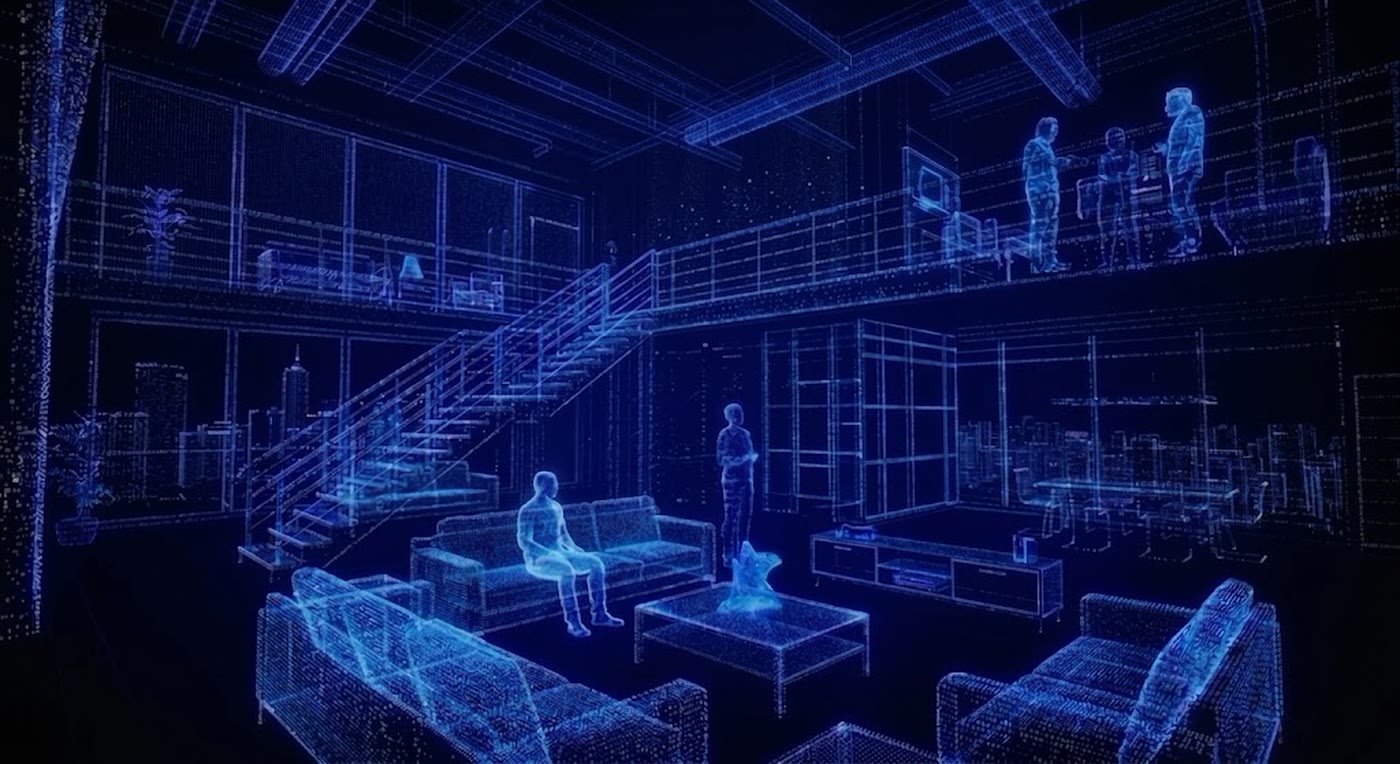
A depth image of an entire building, not a photograph. Every person in it is a wireframe of shape and distance, with no face to recognise.
Unretouched sensor output: the depth image the system works from.
Shape and distance, not faces.
A depth-imaging sensor measures how far away each point in the room is, and the system reads that depth map as posture and movement. It is not a conventional camera with the picture blurred afterwards. Monitoring works from depth data from the start.
- No conventional RGB video used for monitoring
- Reads body posture and movement, with no directly identifiable imagery collected
- Enough spatial detail to recognise a fall, and no identifiable video footage to protect
Sense, analyse, alert.
Every detection follows the same three-step pipeline, run in order, from the sensor's raw depth data to a caregiver's screen.
Seconds, not minutes, from motion to alert.
Sense
A depth-imaging sensor creates a depth map showing the distance and shape of people and objects in the room. It does not record conventional camera imagery.
Analyse
On-device AI reads the depth map and decides what it shows: a bed exit, a fall, a high-risk posture, or nothing that needs attention. It runs on the unit itself, without waiting on a server.
Alert
When the AI confirms a risk, a privacy-preserving depth clip reaches the care team within seconds, so they can check what happened and respond.
What runs on the device.
Six capabilities, processed locally, before anything reaches the network.
Accurate fall and bed-exit detection
Recognises bed exits and falls with 98% accuracy in clinical trial settings, using an AI model trained and validated on over 1 million depth images.
AI that runs on the device
Detection happens inside the unit rather than in the cloud, so an alert does not wait on an internet round trip and the network load stays light.
Follows each person in the room
Keeps track of each person as they move around the room, which is what posture and fall detection build on.
Automatic environment recognition
Recognises the bed and the layout of the room by itself, so nobody has to calibrate the unit or draw detection zones by hand.
Alerts within seconds
When a risk is confirmed, the care team receives a privacy-preserving depth clip within seconds, so they can check what happened before responding.
Posture recognition
Recognises the postures that come before a fall, such as sitting up at the bed edge or climbing over a rail, with a low false alarm rate, so the alerts that arrive are worth acting on.
Privacy by design, not by setting.
For a procurement or compliance review, these are the facts that matter most.
Built into how the system senses, not added on afterwards.
Each point below follows from working with depth data instead of conventional video, rather than from a masking setting or a policy that could quietly change.
No identifiable video
No conventional video or directly identifiable imagery is collected for monitoring. Privacy-preserving depth data is used for detection and alert verification.
No identifiable footage to protect
A camera system records first and restricts access afterwards. SoundEye works from depth data, so there is no identifiable video footage to secure or eventually delete.
Suited to washrooms and private areas
Sensors can be placed where the fall risk is highest, including bathrooms and other spaces where a camera would rarely be approved.
Designed in from the start
Monitoring is built on depth sensing from the ground up, so privacy does not depend on someone remembering to blur, mask or delete video later.
See the pipeline in a real ward.
Hospitals and nursing homes across Singapore and Japan already use it at the bedside. We can show you exactly what it would look like at yours.