Our why
Monitor what matters.
SoundEye was founded in 2015, after a senior living alone fell in a washroom and was not found for three days. Everything we build exists so that a call for help is heard.
A social enterprise, not a surveillance company.
SoundEye was set up as a social enterprise in 2015. The engineering has changed a great deal since then. The brief has not: read enough of a room to know when someone needs help, and nothing more than that.
That principle decides what we build. Depth imaging rather than conventional cameras, processing on the device rather than in the cloud, and an alert that reaches a caregiver within seconds. It is why the system can be put in a washroom at all.
Enough of the room to know someone is getting up, without imagery that could directly identify them.
Enhance safety and quality of life so everyone can live with greater security, independence and dignity.
See it in the wardWhat guides us
Three commitments behind every deployment.
None of them are negotiable, and none of them ask a resident to change how they live.
Privacy first
No conventional cameras and nothing worn on the body. Depth-imaging sensors read posture and movement without collecting directly identifiable imagery for monitoring.
Independence and dignity
Nothing changes about how someone lives. Our systems work silently in the background, asking no one to alter a habit or wear a device, so safety is never traded for dignity.
Rapid response
Every second matters in a fall. When a risk appears, an alert reaches a caregiver within seconds, so a call for help is heard.
Built to process everything on the device.
Depth imaging and edge computing are not two separate features. They are the same decision, made twice, so a resident's situation can be understood right there in the room.
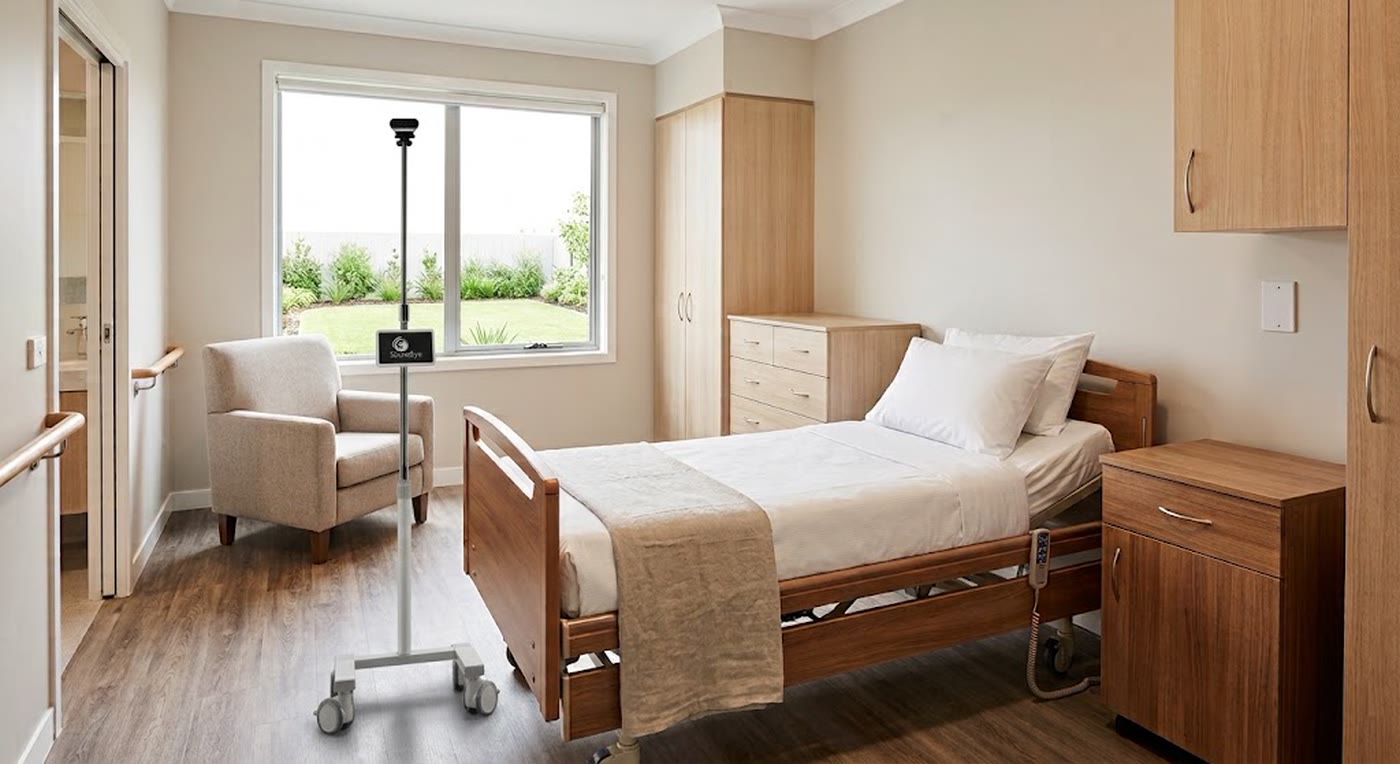
Everything the system decides, it decides inside this unit, in the room.
Three choices, one commitment.
Traditional monitoring asks a family to trade privacy for safety. Every part of the stack below exists to remove that trade.
Depth imaging
Sensors read shape, distance and movement well enough to catch a fall in progress, without collecting directly identifiable imagery.
Edge computing
All AI processing happens on the device itself, keeping network requirements light and response times fast.
Intelligent AI
Trained and validated on over 1 million depth images, the model reaches 98% accuracy for bed-exit and fall detection in clinical trial settings.
This is what every deployment is built toward.
Security, independence and dignity are not just words on this page. Tell us about your facility and we will show you what they look like in practice.