Our solution
LASSO
Bed-exit and fall-risk detection for hospitals and nursing homes. It wheels to whichever bed needs it, recognises the hospital bed on its own, and uses depth sensing instead of conventional camera monitoring.
Every side of it, and not one hole in the wall.
A depth sensor, a bedside touchscreen and a wheeled base. Scroll to turn it.
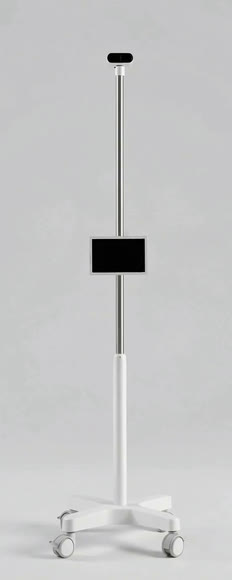
-
Top
A depth sensor, not a conventional camera
It reads shape and distance over the bed, not faces or conventional video.
-
Middle
Set up at the bedside
Everything a nurse needs is on the touchscreen. No laptop, no IT ticket.
-
Base
It rolls to the next bed
The whole argument for LASSO, resting on four castors.
A senior fell in a washroom and went unnoticed for three days.
She survived on toilet water. When we heard that, we knew the problem was not a lack of care. It was a lack of anyone knowing.
Founded in 2015 as a social enterprise, SoundEye develops privacy-preserving technology so that no call for help goes unheard. LASSO is the result: a system deployed across hospitals, nursing homes and public spaces, recognised by government agencies and healthcare institutions for its impact on the people it protects.
Our why
Enhance safety and quality of life so everyone can live with greater security, independence and dignity.
Privacy-preserving by design, not by policy.
LASSO reads shape, distance and movement with depth-imaging sensors. It collects no directly identifiable imagery for monitoring, so there is no identifiable video footage to mask or protect.
No conventional cameras
Depth-imaging sensors, not conventional RGB or thermal cameras. Shape and distance, not faces.
Dignity preserved
Reads body posture and movement without collecting directly identifiable imagery.
Simpler privacy review
No identifiable video. Privacy-preserving depth data is used for detection and alert verification, which keeps procurement and privacy review simpler.
Flexible placement
U-shaped mobile base, or wall and ceiling mounting, with configuration options for most room layouts.
What it sees
Smarter than bed-exit detection.
A fall rarely starts at the moment someone leaves the bed. LASSO recognises the postures that come before it, as they happen, while the situation is still recoverable.
-
Sitting at the edge
The moment before standing, when a fall is still preventable.
-
Kneeling on bed
Unstable kneeling, flagged before it topples.
-
Standing on bed
High-risk standing on the mattress.
-
Climbing over rail
An attempt to climb the side rail, caught early.
-
Bed exit
Where a conventional alarm starts. LASSO flags this too, and everything before it.
Posture is read from shape and distance, so no directly identifiable imagery is collected for monitoring.
The LASSO advantage
Built for how wards actually run.
Fixed monitoring systems assume the ward will adapt to them. LASSO assumes the opposite.
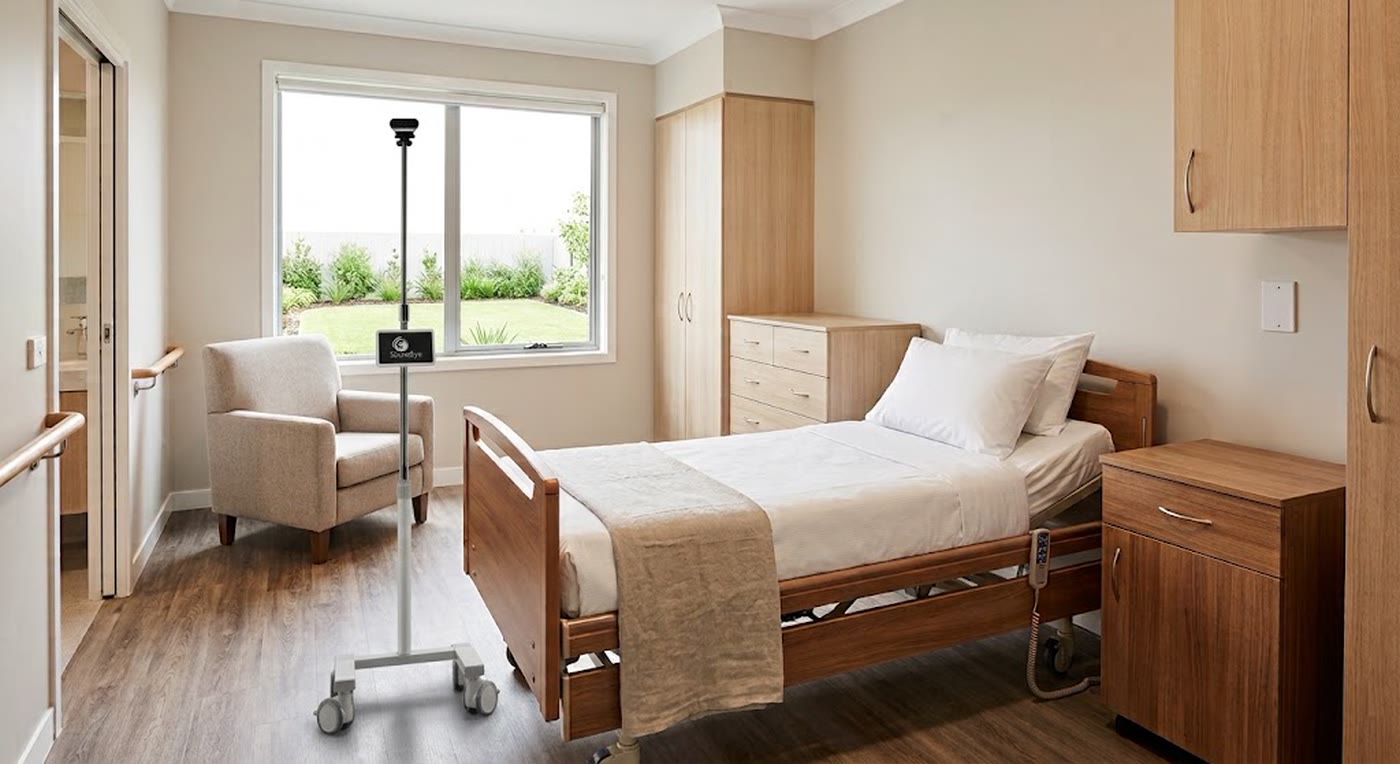
LASSO on its mobile base, wheeled beside the bed it is monitoring tonight.
Monitor any bed, then move it to the next one.
Nurses wheel LASSO to whichever bed needs monitoring tonight. Its U-shaped base is designed to fit partly under the hospital bed, reducing the floor space needed beside the bed. No wall drilling or permanent installation is required with the mobile configuration.
- U-shaped mobile base, designed for tight bedside spaces
- No wall drilling or permanent installation with the mobile configuration
- Avoids the building works a fixed installation needs
- Minimal disruption to patients and ward routines
- Reassign freely as care needs change
1Million+
Depth images used to train and validate the AI that recognises the bed.
Push it in, switch it on, start monitoring.
With an AI trained and validated on over 1 million depth images, LASSO recognises the hospital bed by itself. Position it and power it up. There is no manual calibration and no drawing detection zones by hand.
- Automatic hospital-bed recognition
- No manual calibration by nursing staff
- Redeploys between patients in moments
And it knows when to stay quiet.
Alarm fatigue is the reason ward staff stop trusting monitoring systems. LASSO detects when a caregiver is already at the bedside and holds back the alerts nobody needs.
The patient is alone
LASSO watches for bed exit and the high-risk postures that precede a fall, and alerts within seconds when one appears.
A caregiver arrives
Assisted care looks exactly like a fall risk to a conventional system. LASSO recognises the second presence and stops alerting.
The caregiver leaves
Monitoring resumes on its own. Nobody has to remember to arm it, and nobody has to disarm it first.
LASSO against a conventional fixed system.
A deployment and workflow comparison, at a glance.
| Capability | Conventional fixed system | LASSO |
|---|---|---|
| Permanent wall or ceiling installation | Usually required | Not required with the mobile configuration |
| Move between beds | Limited to prepared rooms | Rolls on its own base |
| Manual calibration or zone setup | Common | Automatic bed recognition |
| Caregiver-aware alert suppression | Varies | Built in |
| Bedside touchscreen configuration | Rarely available | Built in |
| Detection scope | Bed exit only | Bed exit, plus kneeling, climbing and side-rail risk |
LASSO at a glance.
Six capabilities, all running on the device itself.
Bed-exit and fall detection
98% accuracy for bed-exit and fall detection in clinical trial settings, from an AI trained and validated on over 1 million depth images.
AI that runs on the device
Detection happens inside the unit, so alerts do not wait on the network and network requirements stay light.
Follows each person in the room
Keeps track of the patient and anyone with them, which powers posture analysis and caregiver-presence logic.
Automatic environment recognition
Recognises the bed and the room layout by itself, with no manual calibration or zone drawing.
Alerts within seconds
Privacy-preserving depth-image clips reach caregivers within seconds, so an alert can be verified before anyone runs.
Posture recognition
Recognises kneeling, standing on the bed and climbing over a rail, with a low false alarm rate on the ward floor.
Two components. That is the whole system.
Nothing for a resident to wear, charge or remember, and nothing for a family to consent to beyond the room itself.
1. Depth imaging sensor
Captures depth data, not conventional video. Mounts on the U-shaped mobile base, a wall or a ceiling.
2. Processing unit with touchscreen
Runs the AI on-device and gives ward staff configuration and live monitoring at the bedside.
“Our partnership with SoundEye has proven valuable and we are eager to explore how this technology can further enhance resident care in our facility.”
Singapore Christian Home
Bring LASSO to your ward.
Tell us how your ward runs and we will show you what deployment actually looks like, from the first bed to the whole floor.